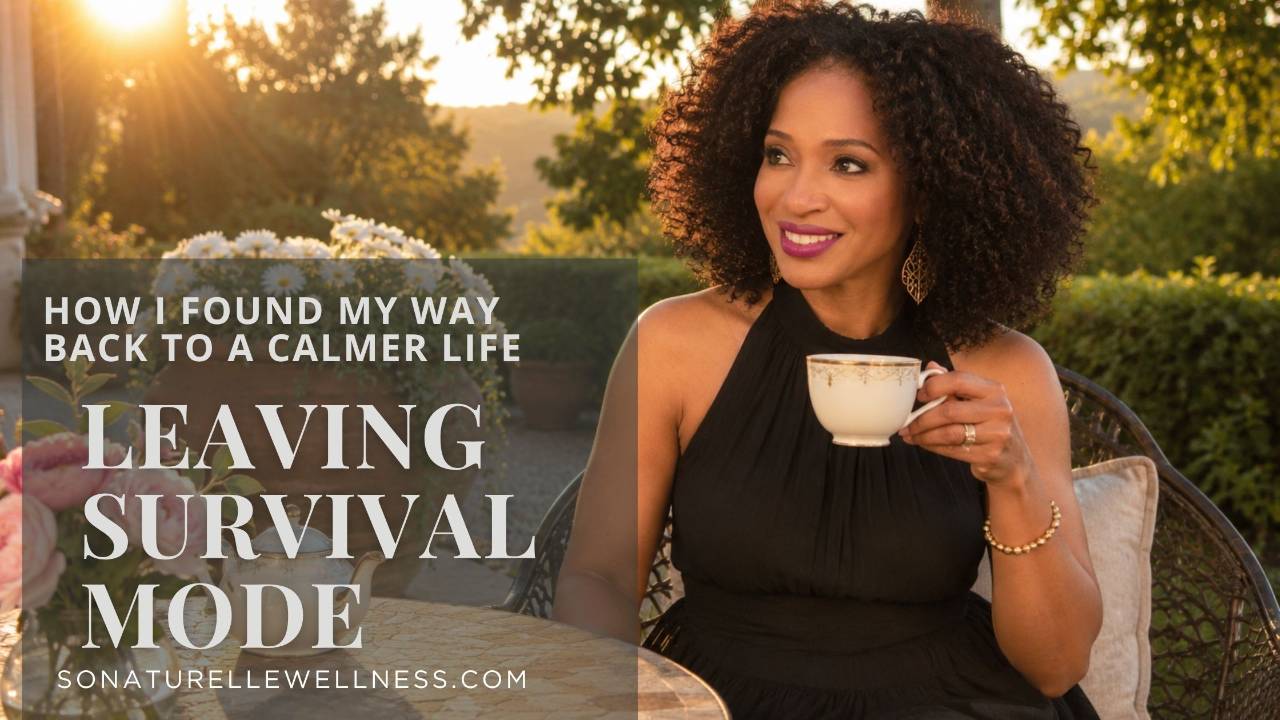
How I Finally Got Out of Survival Mode Without Changing My Whole Life
Aug 30, 2026For a long time, I didn’t realize I was living in survival mode.
I thought I was tired.
I thought I needed more rest. A better schedule. Maybe a little more discipline.
If I could just get organized enough, get ahead enough, or finally catch up on everything that needed my attention, perhaps I would feel better.
But there was a problem.
Even when I had a quiet moment, I didn’t feel quiet inside.
I remember having one of those rare moments when my mother-in-law didn’t need me. Nothing was wrong. There was no crisis to handle.
I could have relaxed.
Instead, my mind immediately started looking for the next thing.
What needed to be done? Had I forgotten something? What was coming later? What did I need to handle for my business, my home, or caregiving?
That was when I began to recognize something I hadn’t been able to see while I was in the middle of it:
"I wasn’t really living my life anymore. I was managing it".
And perhaps you know that feeling too.
Survival Mode Doesn’t Always Look Like Falling Apart
One reason it took me so long to recognize survival mode is that I was still functioning.
From the outside, you might look completely capable.
✔️ You get dressed.
✔️ You answer emails.
✔️ You make dinner.
✔️ You take care of the people you love.
✔️ You keep appointments.
✔️ You remember what everyone needs.
✔️ You continue showing up.
And yet internally, you are always anticipating, always planning and always bracing. After a while you can become so accustomed to being “on” that you stop noticing how much energy it takes.
I wrote about this recently in Why I Was Always On Edge (Even When Nothing Was Wrong.) Sometimes the absence of an immediate crisis doesn’t automatically produce a feeling of calm. Your responsibilities may have slowed down for the moment, but you haven’t.
And that can be confusing.
You may start wondering why you can’t handle life the way you once did—or why everything seems to feel like too much, even when nothing particularly dramatic has happened.
I experienced that too.
But what eventually helped me wasn’t becoming better at carrying everything. It was questioning why I believed I had to.
I Thought Rest Would Fix It
My first instinct was obvious:
I need to rest.
And sometimes I absolutely did.
Physical rest matters.
But I also discovered something that changed the way I thought about overwhelm: You can be sitting down while your mind is still standing at attention.
Maybe you’re on the sofa, but mentally you’re writing tomorrow’s list then you finally get into bed, but you're thinking about something you forgot. The realization set in that you have an hour to yourself, but instead of enjoying it, part of you feels guilty because you should be doing something productive.
I began to understand [why rest wasn’t always working for me].
Rest was part of what I needed, but it wasn't the whole answer.
I had to begin showing myself, in very ordinary ways: Everything does not have to be handled right now.
That became the beginning of a much gentler approach to my life.
I Stopped Trying to Fix My Whole Life
There’s something we often do when we become overwhelmed.
We turn ourselves into another project. We decide we need a completely new morning routine.
- A better diet.
- A perfectly organized home.
- A more efficient schedule.
- A new exercise program.
- A productivity system.
- A complete life reset.
Suddenly, trying to recover from overwhelm becomes one more thing we have to accomplish.
I didn’t need another project.
I needed relief.
So I stopped asking: How am I going to get my whole life under control?
And started asking:
What would make today feel 10% lighter?
Not perfect.
Not completely stress-free.
Just 10% lighter.
That question changed things for me because the answer was usually manageable.
- Sometimes dinner could be simpler.
- Sometimes an email could wait.
- Sometimes I needed to close my laptop earlier.
- Sometimes I needed to stop trying to accomplish five things and choose two.
- Sometimes I needed tea and ten quiet minutes.
- Sometimes I needed fresh air.
And sometimes I needed to admit that something simply wasn’t important enough to receive my energy that day.
None of these decisions transformed my entire life.
But together, they began transforming the way I experienced it.
I Started Taking Small Moments Back
Caregiving made this especially important for me.
When someone depends on you, it is remarkably easy for your day to become organized almost entirely around someone else’s needs.
There are meals.
Medications.
Appointments.
Unexpected situations.
Household responsibilities.
Work.
And the invisible mental load of remembering what needs to happen next.
I love my family. But I also began realizing that if I wasn't intentional about making room for myself, an entire day could pass without one moment that actually felt like mine.
So I started taking some of those moments back.
Not hours.
Moments.
A beautiful cup of tea.
Reading.
Studying French.
Playing my violin.
Sitting outside.
Putting flowers on the table.
Going somewhere beautiful when I had the opportunity.
These things weren't productive.
They didn't solve caregiving.
They didn't eliminate my responsibilities.
And that was precisely the point.
They reminded me:
I'm still here.
There was still a woman underneath the responsibilities.
A woman who was curious.
Who loved learning.
Who loved beauty and good food.
Who wanted to create.
Who could enjoy wandering without needing to accomplish anything.
These small rituals weren't an escape from my life.
They were a way of returning to it.
I Stopped Waiting Until Everything Was Done
Perhaps one of the most important things I had to unlearn was this:
I'll relax when everything is done.
But when is everything done?
If you're caring for someone, running a household, working, raising children, building a business—or simply living a full adult life—there will always be something.
Another load of laundry.
Another email.
Another appointment.
Another phone call.
Another task waiting for tomorrow.
If you only give yourself permission to enjoy your life once everything has been handled, you may spend years waiting for your life to begin.
I didn't want to do that anymore.
I began letting myself enjoy tea even though something was still on my list.
I could read without earning it first.
I could sit outside without making those 15 minutes productive.
I could create beauty in my home simply because beauty made me feel good.
I could experience pleasure in the middle of an imperfect life.
That was a surprisingly powerful shift.
Survival mode had quietly taught me:
Handle everything first. Then you can live.
I began practicing something different:
Life is happening now.
I Gave Myself Permission to Have Different Levels of Capacity
Another thing I stopped expecting from myself was the same level of capacity every single day.
Some days, I have a lot of energy.
Other days, I don't.
Caregiving alone taught me how quickly a day can change.
Instead of interpreting a lower-capacity day as some kind of personal failure, I've learned to adjust.
Maybe today doesn't need five priorities.
Maybe it needs two.
Maybe dinner needs to be easy.
Maybe something gets moved to tomorrow.
Maybe good enough really is good enough.
This can be particularly difficult for capable women.
When you're the person who usually figures things out, people become accustomed to you carrying more.
And eventually, you become accustomed to expecting it from yourself.
But just because I can carry something doesn't mean I always need to.
That realization has become one of my quiet boundaries.
I Started Asking Myself What I Needed
For years, one of the first questions in my mind was:
What do I need to get done today?
I still have responsibilities, so that question hasn't disappeared.
But now there is another question beside it:
What do I need today?
- Sometimes the answer is quiet.
- Sometimes I need movement.
- Sometimes I need conversation.
- Sometimes I need solitude.
- Sometimes I need to create something.
- Sometimes I need a beautiful meal.
- Sometimes I need to play my violin.
- And yes, sometimes I really do need a nap.
The important part is that I'm listening again.
After spending so much time responding to what everyone and everything around me needed, this question helped me begin hearing myself.
It also helped me understand that feeling mentally exhausted wasn't evidence that I had somehow become less capable.
I had simply been carrying a lot for a long time.
Getting Out of Survival Mode Didn't Mean My Life Became Stress-Free
I want to be careful about the phrase getting out of survival mode because I don't want to create another unrealistic picture for women.
My life didn't suddenly become easy.
I'm still a caregiver.
I still have responsibilities.
I still experience difficult days.
Unexpected things still happen.
And yes, there are times when I feel myself slipping back into that familiar pattern of rushing, anticipating and trying to handle everything.
The difference is that I recognize it now.
I know some of the ways I can come back.
I simplify.
I make space.
I return to my little rituals.
I ask what actually matters today.
I allow something to be good enough.
I stop treating every thought as something that requires immediate action.
And I find something—however small—that reminds me I'm a person, not simply a collection of responsibilities.
Survival mode wasn't somewhere I escaped from once and never visited again.
I learned how to stop living there.
Your First Step Doesn't Have to Be Big
If you've been overwhelmed for a long time, please don't turn this into another list of things you're supposed to do perfectly.
Start smaller.
Tonight, ask yourself one question:
What would make tomorrow feel 10% lighter?
Then pay attention to your answer.
Not what you should need.
Not what someone on social media says your morning routine should look like.
Not what the most productive version of you would choose.
What do you actually need?
Maybe you need ten quiet minutes.
Maybe you need to say no.
Maybe you need help.
Maybe something needs to come off your list.
Maybe you need to go outside.
Maybe you need to put on music, make tea, open a book, or simply sit somewhere beautiful for a few minutes.
Your life doesn't have to be completely transformed before you begin experiencing it again.
Sometimes coming back to yourself begins with one small moment that says:
This part of the day belongs to me.
🌿 Ready for a Gentler Reset?
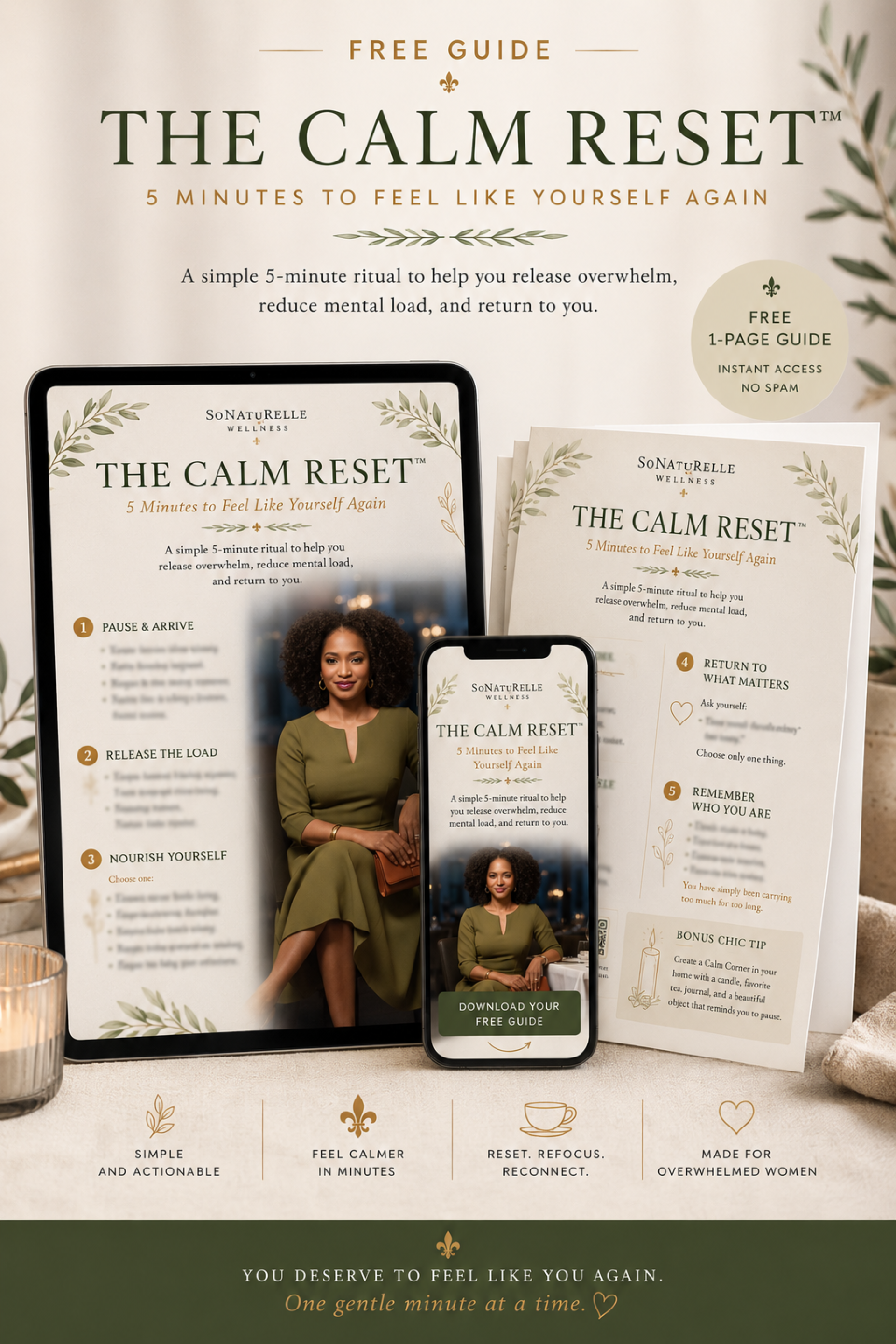
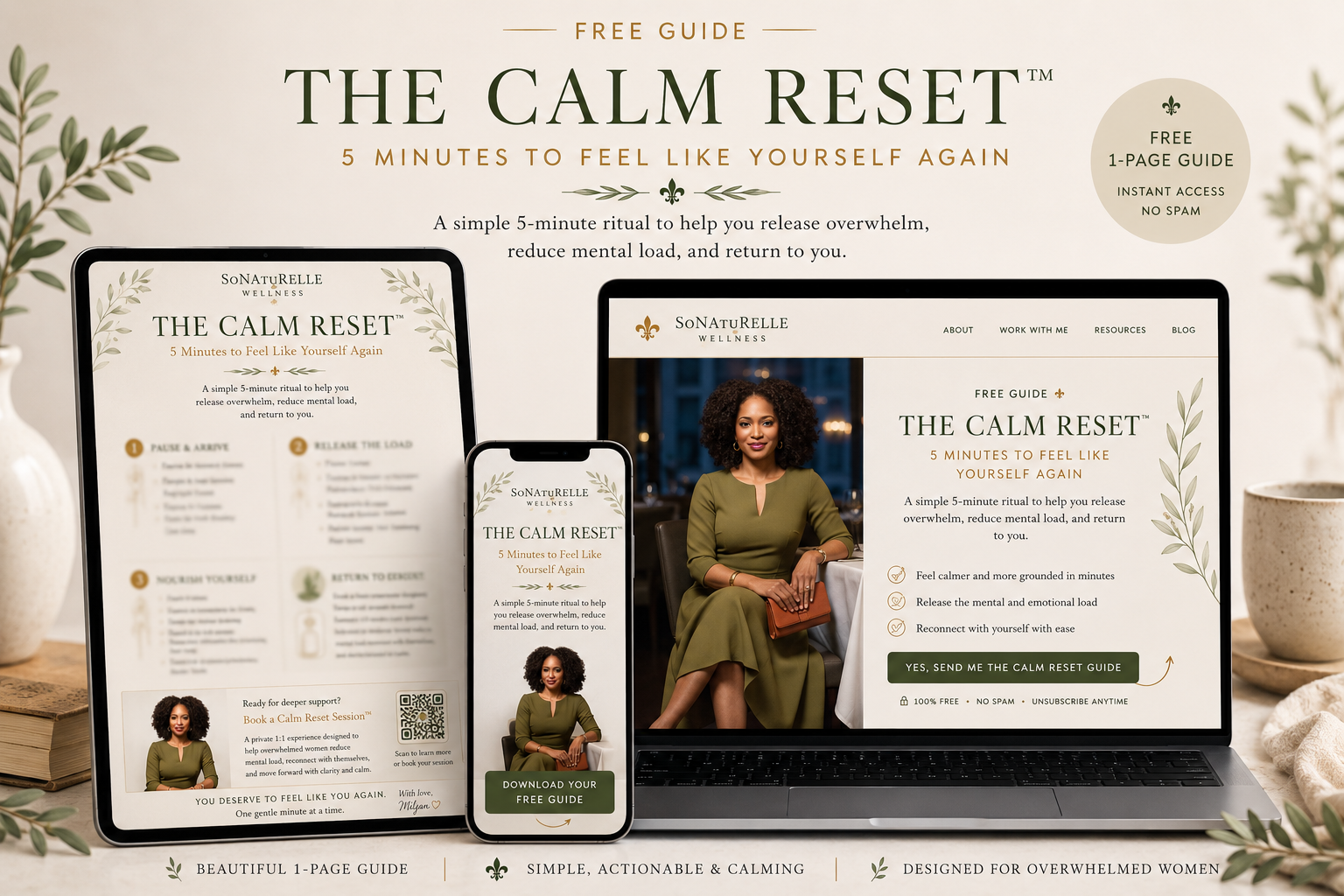
If you're reading this and thinking, I don't even know what I need anymore, that's exactly why I created my Calm Reset Guide.
It's designed to help you slow the overwhelm and begin creating more space for yourself—without another complicated routine or an overhaul of your entire life.
And if this article resonated with you, read [Why Rest Isn't Working] next. It will help you understand why simply stopping isn't always enough when you've spent so long carrying so much.
About Milan Perry
Milan Perry is a Stress Management and Wellness & Lifestyle Coach and founder of YouTube Channel SoNaturelle Living, where she helps overwhelmed women create calmer, more intentional lives without believing they have to reinvent themselves first.
Her perspective combines wellness education with lived caregiving experience and an approach centered on practical stress management, nourishing rituals, intentional living, and making room for beauty and pleasure in everyday life. Through SoNaturelle Living, Milan writes and speaks about overwhelm, caregiving, midlife wellness, French-inspired living, and what it means to feel like yourself again. 🌸