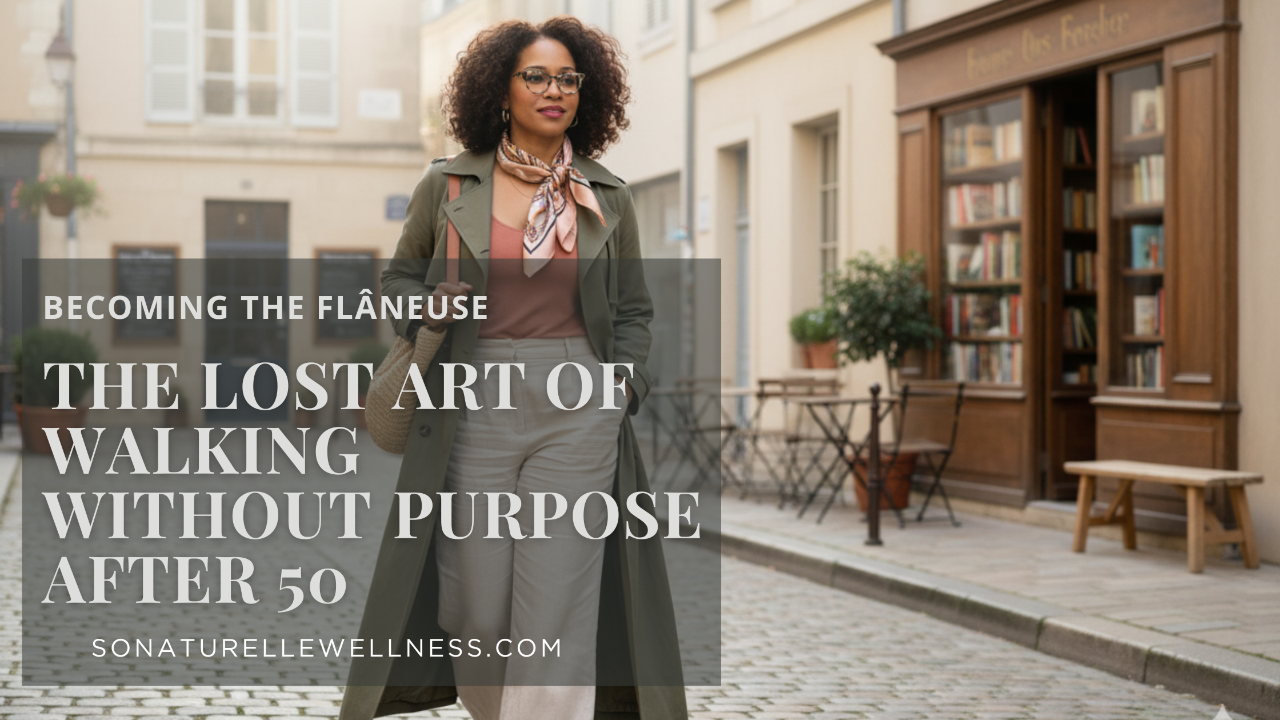
Walking Without Purpose Is a Radical Act & Why Wandering Restores Your Mind After 50
Mar 11, 2026There was a time when walking had no agenda.
You stepped outside simply to feel the air, to watch the trees move, to notice the rhythm of the street. You wandered slowly, observing the world and yourself at the same time.
But somewhere along the way — especially for women in midlife — walking became another task.
10,000 steps.
A cardio workout.
A quick errand between responsibilities.
The quiet act of wandering disappeared beneath productivity.
And yet something extraordinary happens when you walk without purpose.
Your nervous system begins to soften.
Your mind becomes less crowded.
Your emotional world begins to reorganize itself.
This practice is part of what I call becoming the flâneuse — a slower and more intentional way of moving through life.
In a culture that rewards constant motion, choosing to slow down and wander is quietly radical.
🌿
Why Constant Productivity Exhausts Women Over 50
Many women reach midlife carrying an invisible workload.
They have spent decades caring for children, supporting partners, maintaining households, building careers, and often caring for aging parents as well.
Responsibility becomes second nature.
But something rarely discussed happens to the nervous system after years of this pattern.
The body learns to live in continuous activation.
Even during moments that should be restful, the mind remains alert:
-
planning the next task
-
anticipating problems
-
carrying emotional responsibility for others
Over time this creates a subtle but persistent exhaustion. Not just physical fatigue — but mental saturation.
Many women believe they simply lack discipline or energy. But often what they are experiencing is something different:
Their nervous system has forgotten how to downshift.
This is why practices that seem simple — like wandering slowly — can feel strangely unfamiliar. But simplicity is precisely what restores balance.
Many women realize they have spent years moving through life on autopilot — something I explore more deeply in The Café Is Not the Point: Learning to Observe Yourself Again.
The Neuroscience of Slow Walking
Modern neuroscience increasingly confirms something the human body has always known:
Slow, rhythmic movement regulates the nervous system.
When you walk without urgency, several physiological shifts occur:
Your breathing deepens.
Your heart rate stabilizes.
Your brain moves out of high-alert mode.
The body begins to transition from the sympathetic nervous system (fight-or-flight) into the parasympathetic state — often called the “rest and restore” mode.
This is where healing and emotional clarity occur.
Slow walking also stimulates bilateral movement — the natural left-right rhythm of the body.
This gentle alternating motion has been shown to support emotional processing in the brain.
It’s one of the reasons walking often helps people think through problems more clearly.
But wandering adds something even more powerful:
Observation.
One of the quiet practices of the flâneuse is learning to slow down enough to think clearly again — something I discuss more deeply in When Doing Less Restores More.
How Observation Restores Emotional Clarity
The flâneuse is not simply someone who walks.
She observes.
She notices the light on a building.
The sound of a distant conversation.
The quiet beauty of everyday life.
Observation shifts the brain from analysis to awareness.
Instead of forcing answers, the mind begins to settle.
This is where many women rediscover something they lost during years of responsibility:
Their own inner voice.
When the nervous system calms, emotions surface in a manageable way.
Ideas appear.
Insights return.
Often the clarity we are searching for does not arrive through effort — but through space. And wandering creates that space. ✨
It allows you to become a participant in life again, not just its manager.
Many women rediscover their love of reflection through small daily rituals like reading, journaling, or slow wandering — practices I explore more in Reading as a Ritual, Not a Hobby
Creating a Daily Wandering Ritual
You do not need hours for this practice.
In fact, one of the most powerful aspects of wandering is its accessibility.
Even 10 to 20 minutes can reset your internal rhythm.
The key is removing intention.
This is not a workout.
Not an errand.
Not a productivity tool.
It is a return to presence.
Here are a few simple ways to begin:
Leave your phone in your pocket
Avoid turning the walk into content, messages, or podcasts.
Silence creates mental spaciousness.
Walk slowly
There is no destination.
Allow yourself to move at a natural pace rather than a performance pace.
Look outward
Notice architecture, trees, colors, textures, people.
Observation gently pulls the mind out of rumination.
Let thoughts pass
If worries arise, do not chase them.
Walking allows thoughts to move through the mind rather than accumulate.
End with a pause
Before returning home, take a breath and simply notice how you feel.
Often the shift is subtle — but real.
Over time, wandering becomes less of an activity and more of a relationship with the world.
A Different Way of Moving Through Life
Many women believe reinvention requires dramatic change.
A new career.
A new goal.
A complete life overhaul.
But often transformation begins with something quieter.
A pause.
A walk.
A moment of noticing.
This is the deeper invitation behind wandering.
Not escape — but reconnection.
And it is one of the small practices that begins the journey of becoming the flâneuse. A woman who moves through life with presence, curiosity, and grace.
If you’d like to explore this philosophy more deeply, I invite you to read Becoming the Flâneuse: How to Slow Down Without Changing Your Life, where I share how small shifts in attention can transform how you experience everyday life.
Inside, I share how small shifts in attention can completely transform how you experience your days.
And if you are at a point in life where you feel disconnected from yourself — something many women experience in midlife — the work we do inside Awaken the Woman Within helps you gently reconnect with your inner rhythm, your desires, and the life you are ready to create next.
Because the goal is not simply slowing down.
The goal is coming back to yourself.


Continue Exploring the Flâneuse Series
-
Walking Without Purpose Is a Radical Act
-
When Doing Less Restores More
-
Reading as a Ritual, Not a Hobby
-
How the Flâneuse Moves Through Overwhelm
About the Author
Milan C. Perry is a Stress Management Coach and Wellness & Lifestyle Coach who helps women over 50 reconnect with themselves through elegant self-care, holistic wellness, and intentional living. Through her programs, writing, and teaching, she guides women toward a more balanced and beautiful way of living — one that supports both wellbeing and reinvention.